Basement Flooding Cleanup in Joplin, MO
Basements take on water for reasons that have nothing to do with each other — a sump pump that quits at the worst possible moment, a heavy storm that overwhelms the yard faster than it can drain, a crack in an old foundation wall that's been slowly widening for years. Whatever brought the water in, a flooded basement in Joplin needs to be pumped out, dried, and checked for what let the water in to begin with, not just mopped and forgotten until it happens again.
Joplin Water Damage handles basement flooding cleanup for homes across Joplin and Jasper County: water removal, structural drying, and straight answers about what caused it.
Why Joplin Basements Flood
A few patterns show up again and again in this area. Spring and early-summer storms can drop a serious amount of rain in a short window, and a yard that drains fine most of the year can't keep up when that much water hits at once, especially on a lot that slopes toward the house instead of away from it. Sump pumps fail at exactly the wrong time, often during the same storm that knocks out power. Older foundations, particularly in neighborhoods that go back to Joplin's mining era, were built to a different standard than modern basements and develop cracks and failure points that newer construction doesn't have.
Then there's the ground itself. Parts of Jasper County sit on ground shaped by a century of lead and zinc mining, plus natural karst limestone underneath a lot of southwest Missouri — neither drains as predictably as an ordinary clay lot, and water can move toward a foundation in ways that don't show up until it's already inside.
What Basement Cleanup Involves
A proper basement flooding cleanup goes well past pumping out what's visible:
- Water removal. Pumps for standing water, extraction equipment for what's soaked into carpet and pad
- Assessment of what's salvageable. Boxes and furniture react differently than framing and drywall — some of it can be saved, some can't
- Moisture mapping. Checking behind walls and under flooring, since basement water tends to travel further than it looks
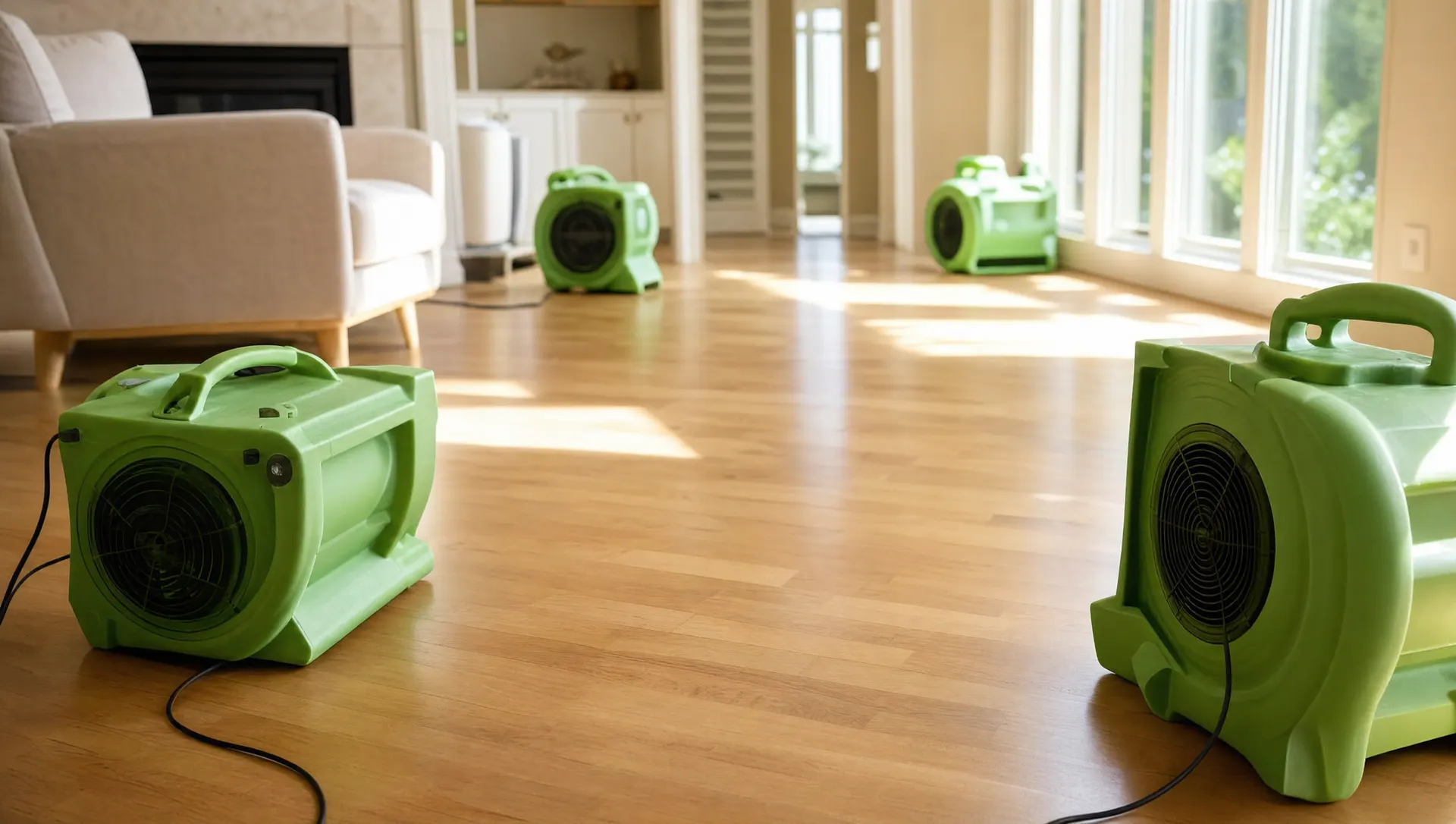
- Drying. Air movers and dehumidifiers sized for a below-grade space, which typically holds moisture longer than a room upstairs
- A look at the cause. Cleaning up the water without figuring out why it got in usually means doing this again next storm
If the water backed up through a floor drain rather than coming in from outside, that's a different situation — see sewage backup cleanup.
Sump Pumps, Foundations, and Joplin's Ground
Most basement flooding traces back to one of a few sources, and the fix depends on which one you've got. A failed sump pump is usually the simplest problem — the pump gets replaced and, ideally, a battery backup gets added so the next power outage during a storm doesn't repeat the flood. A foundation crack is a longer conversation, since it usually needs a look from someone who handles foundation repair, not just cleanup.
The trickiest cases are the ones tied to Joplin's ground itself — old mine workings and karst limestone that shift how water moves underground, sending it toward a foundation from a direction that isn't obvious by looking at the yard. Homes in and around older sections of the city, plus nearby areas like Duquesne and Oronogo that share that mining history, see this more often than newer subdivisions built on undisturbed ground.
A One-Time Flood Versus a Chronic Problem
Not every wet basement is a single dramatic event. Some show up as a sudden flood after one bad storm; others are a slow, chronic issue that shows up as a musty smell, chalky white mineral deposits on block walls, or carpet that never quite feels dry even weeks after the last rain. The cleanup itself is similar either way, but a chronic problem usually points to an ongoing source, like a persistent grading issue or a foundation crack that weeps every time it rains, rather than a one-time failure like a burst pipe.
Telling the two apart matters, because a chronic leak that gets cleaned up without being diagnosed will simply come back, often worse, since materials that dry out and get wet repeatedly break down faster than materials that flood once and get dried properly. If your basement has smelled musty for longer than you can pin to a single storm, mention that up front — it changes what we look for.
Cost to Clean Up a Flooded Basement
Basement cleanup costs typically scale with how much square footage got wet, how long the water sat, and what's actually down there — a basement with finished walls, carpet, and drywall costs more to dry and repair than an unfinished space with a bare concrete floor and a few storage totes. Most residential basement flooding cleanups land in a broad range similar to other water losses, roughly $1,300 to $6,000, with larger finished basements or longer-standing water running higher. We'll give you a real number after seeing the actual space, not a guess over the phone.
Insurance and Basement Water
This is the part that catches people off guard: standard homeowners insurance usually does not cover basement flooding caused by groundwater seeping in or surface water running in from outside — that typically requires separate flood insurance. What is often covered is a sudden mechanical failure, like a burst pipe or a water heater that lets go in the basement. Sump pump failure coverage is frequently a separate rider that not everyone has added to their policy. If you're not sure what your policy actually covers, check it before the next storm, not during the cleanup, and see our FAQ page for more on how coverage typically breaks down.
Stopping the Next Flood
Cleanup solves today's problem. Preventing the next one usually means addressing whatever let the water in — regrading soil so it slopes away from the foundation, adding or upgrading a sump pump with battery backup, sealing a foundation crack, or extending downspouts further from the house. We'll tell you plainly what we think caused the flooding so you can decide what's worth fixing, instead of just drying the same basement out again next spring.
Get Your Basement Handled
A flooded basement doesn't get better by waiting it out. Tell us what's going on — how much water, how long it's been there — and we'll get cleanup moving for your home anywhere in the Joplin area.
Need Help in Joplin Right Now?
Tell us what you need and we'll get back to you fast with a free, no-pressure quote.